
Mythology Meets The 60’s
“Critic’s Best of ’99” Selection
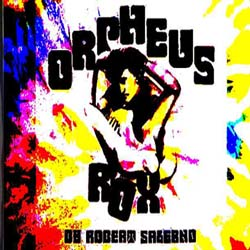
“Orpheus Rox will never fade from memory.”– S. D. Theatre Scene
“Clever, ambitious, guffaw-funny show!”— Back Stage West/Drama-Logue
“Those who want to revisit the 60’s should love this literate, kaleidoscopic show!”—VillageNews
“Fun and playful multimedia journey through American pop-culture history”–S.D. Union-Tribune
Orpheus Rox Reviews
“Orpheus Rox will never fade from memory.”– S. D. Theatre Scene
“Orpheus Rox”: Myth Mostly Hits— The Village News
La Jolla playwright Robert Salerno’s new play, “ Orpheus Rox” is surely literate, intimately and amusingly acquainted with the panoply of Greek gods, their liaisons, infighting, and human qualities. The audience hopefully brings a nodding acquaintance with mythology to the play. A memory of or nostalgia for the ’60s also helps.
Gods above, humans below, and video clips on monitors throughout the huge playing area at the World Beat Center in Balboa Park lend Orpheus Rox a kaleidoscopic feel that goes right along with its hallucinogenic hero, a rock musician named Orpheus. Orpheus shows character and talent, so Apollo and Zeus decide to invest him with greatness and fame in the hope that he will usher in a new Golden Age. Dionysus, god of the Bacchanal, has other plans.
Drugs go hand in hand with the world of Rock and Roll, and Dionysus has a few tricks named pot, pills, and LSD up his toga. On earth, Dionysus is abetted by Orpheus’ musically untalented, brother, Aristaeus. His timing just right, Orpheus enhances the Age of Aquarius, spouting brotherhood and love. The playwright’s video takes us to Woodstock, with clips of Jimi Hendrix and the Grateful Dead (how apropos.
Salerno also teases our bedazzled eyes with clips from old film and television shows and his own dreamlike sequences filmed at local seashore and woods. Especially haunting is footage of Charon ferrying Orpheus’ ladylove, a young social worker named Eurydice, to Hades.
This is an ambitious project, and Vantage Theatre must be applauded for attempting to realize Salerno’s vision with limited resources and a large, valiant company of accomplished actors. La Jolla Playhouse tried something similar with Randy Newman’s “Faust”, and the results were similar, even though their resources were ample.
Salerno opines on three decades of social and political history. As pop music moves from rock to heavy metal, and punk (those Maenads are great as an all-girl group), Wendy Carol’s costumes tell all. Salerno’s dialogue is generally respectable and occasionally guffaw funny.
Leading roles are handled adroitly. Wiener and Rhodes are appealing as the lovers, separated by a drug-induced coma rather than the mythological snakebite. On a platform above the action, the gods fight each other and the acoustics. Jason Lee and Dori Salois (who also directed) shine as Apollo and Athena.
Meanwhile, those who want to revisit the ’60s (there’s even a chance to dance with the Orpheus Rox company and eat pot-free brownies) should love this complicated, clever, and hallucinogenic show.

Orpheus and Eurydice at the Be-In
“Orpheus Rox” in Updated Roles— San Diego Union-Tribune
The World Beat Center, where Vantage Theatre is staging its workshop production of Robert Salerno’s “Orpheus Rox,” is a crazy delight for the eyes, crowded with sculpture and beads, screens and masks. It is the perfect setting for “Orpheus Rox,” Salerno’s multimedia theater journey through American pop-culture history from the 1960’s to the 1980’s. In the center ring, the play gives us Orpheus, a rock ‘n’ roll legend who must undergo a loss of innocence to achieve wisdom. Above us, a chorus of Greek gods bickers and meddles with Orpheus’ destiny.
Video screens project historical events (Hiroshima, the Beatles craze), as well as clips and other re-enactments of Greek mythology. The script is strongest when the characters forget their own mythological and historical importance and just play scenes.
The production has an admirably fun and playful spirit. Director Dori Salois calls the performance a “be-in,” and cites Jerzy Grotowski as a stylistic inspiration. The audience is encouraged to move about the space, and one scene features performers serving Kool-Aid and brownies and dancing with the spectators.
Experimental Theater techniques from the 1960’s seem appropriate for a play so clearly celebrating that decade as our last, best chance for a Golden Age.
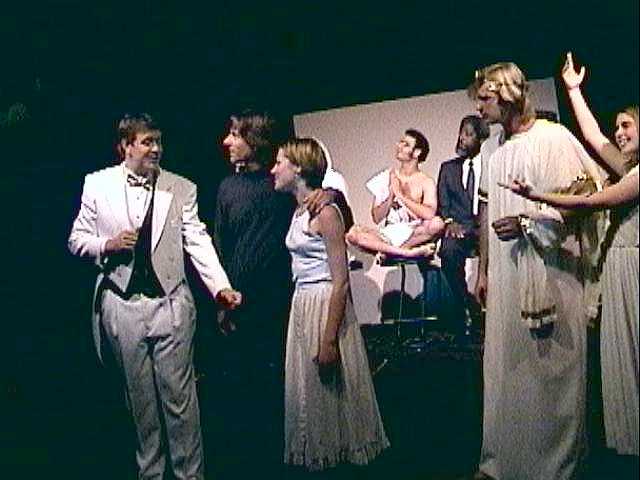
Post-Mortem Review as 50’s Quiz Show
“Orpheus Rox”— Back Stage/Drama-Logue
Robert Salerno’s new play Orpheus Rox superimposes the Orpheus myth on a 1960s sensibility. Salerno is intimately acquainted with the panoply of Greek gods, their liaisons, infighting, and human foibles, and he expects his audience to have at least a nodding acquaintance with same; the broader one’s knowledge of the classics, the more amused one may be. A memory of or nostalgia for the ’60s also helps.
Gods above, humans below, and film and video clips on monitors throughout the huge playing area at the World Beat Center in Balboa Park lend Orpheus Rox a kaleidoscopic feel that goes right along with its hallucinogenic hero, a rock music player named Orpheus endearingly played by Adam Wiener. Orpheus shows character and talent, so Apollo (Jason Lee) and Zeus (McKiever Jones III) decide to invest him with greatness and fame in the hope that he will usher in a new Golden Age. That reprobate Dionysus (Vincent Baca) has other plans.
In addition to regulation joy juice, Dionysus has a few tricks like pot, pills, and LSD up his toga. His plan to debase Orpheus is effected by Orpheus’ musically untalented, road manager brother, Aristaeus (Francisco Torres). Orpheus embodies the Age of Aquarius, spouting brotherhood and love. Video shows us Woodstock, clips of Jimi Hendrix and the Grateful Dead, and scenes filmed at local beaches and woods. On film, Charon ferries Orpheus’ lady love, a young social worker named Eurydice (Erin Rhodes), to Hades.
The ambitious project is mounted by Vantage Theatre, laudably attempting to realize Salerno’s vision with limited resources and a large, valiant, and uneven acting company. Wiener and Rhodes are appealing as the lovers, separated by a drug-induced coma rather than the mythological snakebite. On a platform above the action, the gods fight each other and the acoustics. Jason Lee and Dori Salois (who also directed) shine as Apollo and Athena.
Orpheus Rox has resonance with Randy Newman’s Faust and Stephen Metcalfe’s The Incredibly Famous Willy Rivers. Salerno opines on three decades of social and political history. He allows pop music to devolve from rock to heavy metal to punk.
Salerno’s dialogue is generally respectable and occasionally guffaw funny. Meanwhile, those who want to revisit the ’60s, dance, and eat pot-free brownies should love this complicated, clever, and hallucinogenic show.
Author’s Note: Orpheus Rox
A rock superstar loses the innocence of his original vision simultaneously with the culture’s loss of its ideals, as the 1960’s devolve into the 80’s.
The play retells the archetypal Orpheus myth within the context of 1960’s-1980’s America. The hero is a rock star who is chosen by the god Apollo to introduce a cultural renaissance into the spiritually barren cold war society of the late 1960’s. It is to be a new “Golden Age” for the Earth, based on an expanded vision of the nature of human existence and the principles of universal human brotherhood, harmony, and tolerance.
Structurally, the play contains a unique dynamic equilibrium between three distinct elements. First, the action onstage represents the life of the 60’s rock star. Second, the Gods, located on an elevated platform, serve as a kind of chorus—commenting and wagering on the action, as they constantly bicker among themselves. We see the mighty struggle between Dionysus and Apollo, who battle each other by manipulating events on Earth
Finally, there is the video element. This is used to depict historical events as well as a series of prophetic dreams, sent to the hero by Apollo, in which Orpheus re-enacts the archetypal Greek myth. These serve to refresh the audience’s recollection of the ancient myth and foretell events of the play’s modern action on stage. At one point, Orpheus becomes unable to distinguish dream from reality, and action is portrayed simultaneously onstage and on multiple video monitors placed throughout the theater. Familiar song fragments from the era (with their emotionally potent sense memories) are employed to support and enhance the dramatic action.
The love story of Orpheus and Eurydice serves as a metaphor for the archetypal theme of the loss of innocence. The hero, like the flower power culture of the 60’s, loses the innocence of his original vision and eventually succumbs to the dissipation of drugs, which leads to his ultimate downfall. To regain his love, he must go through the hell of drug rehab. But he stumbles again, and tragedy ensues. There is redemption, however. In the Epilogue, we are given a universal message of hope for the millennium:
Human beings and cultures alike cycle through experiences which involve self-consciousness shattering the blissful illusions of the innocent state, in order to evolve to a higher level of understanding and awareness. Pain is inevitably involved, but– in the end– hope ever leads us to fearlessly enter the darkness of nether regions to regain the light.
Robert Salerno
La Jolla, CA
ORPHEUS ROX
MYTHOLOGY CHEAT SHEET

Orpheus and Eurydice
One of the most universal and misunderstood of all the world myths. Orpheus is the son of Apollo, god of music, medicine, and prophecy, and Calliope, one of the nine muses. He is endowed with such prodigious musical talent that wild beasts, trees, and rocks are said to have wept when he played for them.
Orpheus was a member of the legendary Argonauts, a group of mythic heroes who sailed to the end of the world to retrieve the “Golden Fleece.” On their return voyage, Orpheus saved the mission from the treacherous Sirens by singing a song so powerful that the sailors were not lured by the irresistible chants of the evil women.
Upon his return to Greece, Orpheus meets and marries the lovely Eurydice. They are desperately in love, but, on their wedding day, a bizarre and tragic series of events is set in motion. Aristaeus, lord of bees, is smitten by Eurydice during the wedding celebration and he chases her through a field where she is fatally wounded by a poisonous viper.
Orpheus is overcome with grief, but eventually resolves to venture into the underworld to seek the release of his beloved. As he descends, he charms Charon, the ferryman of the river Styx, and the vicious three-headed dog, Cerberus, who guards the gates of Hades. His magical music causes all suffering to cease, and he soon charms Persephone, the Queen of the Underworld. She is so moved that she pleads with the stonehearted Hades to let Eurydice be released. Eventually she wins him over, but he imposes one simple condition. Orpheus must not look at Eurydice until they have crossed back to the normal world again.
As they are taking the last step, Orpheus looks back and he looses Eurydice for good. He retires once again to the woods in deep despair and sings the saddest song the world has ever heard. In a neighboring meadow, a group of Maenads— wild women followers of the cult of Dionysus— are holding one of their intoxicated, orgiastic celebrations. They notice Orpheus and invite him to join in their dance, but his grief is all consuming, and he doesn’t notice them. Enraged, they descend on him like the Furies. They dismember and behead him, throwing his parts into the river. The last image of Orpheus is his severed head, floating in the river, still crying the name of his beloved Eurydice.
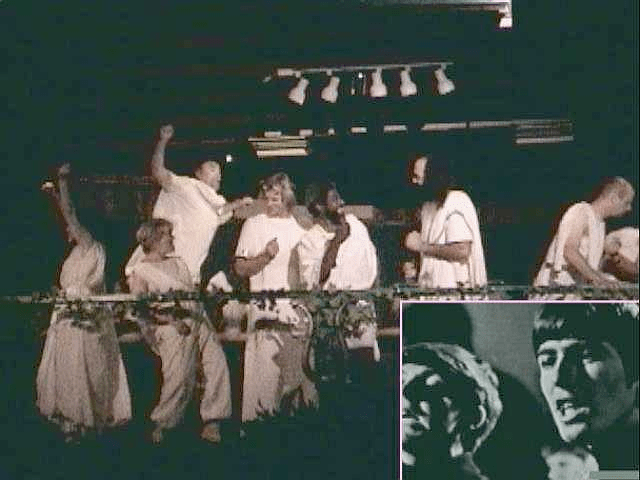
THE GODS
Zeus deposed his father, the Titan Cronus to become the god of the sky and ruler of the Olympian gods. At the same time, Zeus is described as falling in love with one woman after another and resorting to all kinds of tricks to hide his infidelity from his wife, the jealous Hera.
Apollo: Son of the god Zeus and Leto, daughter of a Titan. In Homeric legend Apollo was primarily god of prophecy, and he sometimes gave this gift to mortals whom he loved. Apollo was also god of music, light and truth. He taught humans the art of healing. He was also a master archer and a fleet-footed athlete, credited with having been the first victor in the Olympian Games. Apollo was the special protector of young men.
Dionysus, a son of Zeus, became the popular Greek god of wine and cheer. He was also a deity whose mysteries inspired ecstatic, orgiastic worship. The Maenads, or Bacchantes, were a group of female devotees who left their homes to roam the wilderness in ecstatic devotion to Dionysus at the orgia. These frenetic celebrations became occasions for licentiousness and intoxication. Dionysus, who became Bacchus in the Roman pantheon, was good to those who honored him, but he brought madness and destruction upon those who spurned him or the orgiastic rituals of his cult.
Athena sprang full-grown and armored from the forehead of the god Zeus .
Athena was the goddess of the Greek cities, of industry and the arts, and of wisdom; she was also goddess of war and protector of heroes. She was born directly out of Zeus’s forehead.
Hades: God of the dead, brother of Zeus and Poseidon. With his queen, Persephone, whom he had abducted from the world above, he ruled the kingdom of the dead. Although he was a grim and pitiless god, unappeased by either prayer or sacrifice, he was not evil. The underworld itself was often called Hades. It was divided into two regions: Erebus, where the dead pass as soon as they die, and Tartarus, the deeper region. It was a dim and unhappy place, guarded by Cerberus, the three-headed, dragon-tailed dog. Sinister rivers separated the underworld from the world above, and the aged boatman Charon ferried the souls of the dead across these waters.
Hermes: Messenger of the gods. As the special servant and courier of Zeus, Hermes had winged sandals and a winged hat and bore a golden Caduceus, or magic wand, entwined with snakes and surmounted by wings. He conducted the souls of the dead to the underworld and was believed to possess magical powers over sleep and dreams. Hermes was also a dangerous foe, a trickster, and a thief.
ORPHEUS ROX CAST
ORPHEUS: (early 20’s) Visionary, idealistic, magically talented,. The leading rock star of the late 60’s. Consumed with his mission and his vision. Lives in two worlds.
ARISTAEUS: (mid 20’s) His clever, cynical, scheming brother. Worldly wise.
EURYDICE: (early 20’s) Orpheus’s soul mate. Grace with uncompromising innocence. Intuitive.
APOLLO: (mid 30’s) Golden boy of the Gods. Great at everything, esp. Music, Healing, Prophecy. Earth advocate. Straight and true.
DIONYSUS: (45) God of Wine and bitter Rival of Apollo. Likes a good time and a good fight.
ATHENA: (mid 20’s) Goddess of Wisdom and Protector of Heroes. Earnestly assertive. Has a secret crush on Apollo.
ZEUS: (late 50’s) Trying to balance administration of Olympus with his own lusty pursuits.
HERMES: (late 30’s) A wiseguy who always complains about being overworked. Bitchy and sarcastic.
ARES: (early 30’s) Frat-boy War God.
APHRODITE:(30-ish) Sexy Goddess of Love. Marilyn in a toga.
HADES: (80’s) God of the Underworld as a cranky, slightly senile, old Jewish guy from NYC.
PERSEPHONE: (late 40’s) Hadassah Queen of the Underworld.
HECTOR: (11) A street savvy inner-city kid, inspired to rise from the East Village.
SAMAEL: (40’s) Record Company Executive. Slick, powerfully evil. The Devil in an Armani suit.
HYDRA: (late 20’s) Sexy Seductress. A monster under the control of evil forces.
CLYMENE: (late teens) Archetypal, sweet flower child.
MAENADS: (late teens) Punk lesbian band with a bad attitude and poor impulse control.
MAGISTRATE: (early 50’s) Ringmaster of the Universe as game show host.
JOAN: (late teens) French country girl.
HYPATIA: (late 40’s) Martyr of Alexandria.
GANDHI: (78) Hindu Hero.
SOCRATES: (69) Greek Gadfly.
M. L. KING: (39) Minister of Humanity.
PROMETHEUS: (20-ish) New Teen idol.
ARGONAUTS (JASON, PELEUS, POLLUX) (early 20’s) Band members.
DOCTOR: Played by actor who plays Hades
NURSE: Played by actor who plays Persephone.
REPORTERS
M.C.
PAGE
 Vantage Theatre